

What would a Forward Deployed Engineer at Palantir see in a socialist politician like Zohran Mamdani?
Or, for their part, rank-and-file employees at Lockheed Martin, Raytheon, Bae Systems, and Northrop Grumman? On one side, you have products like Maven, Palantir’s technology that optimizes targeting decisions (what they call the “kill chain”), or Hellfire missiles and GBU-38 JDAM guidance kits manufactured by Raytheon. And on the other side, the promise of fast, free buses, free childcare, a rent freeze, alongside the unequivocal view that Israel is carrying out genocide in Gaza. These worlds seem entirely disconnected from one another. Turns out, they’re not.
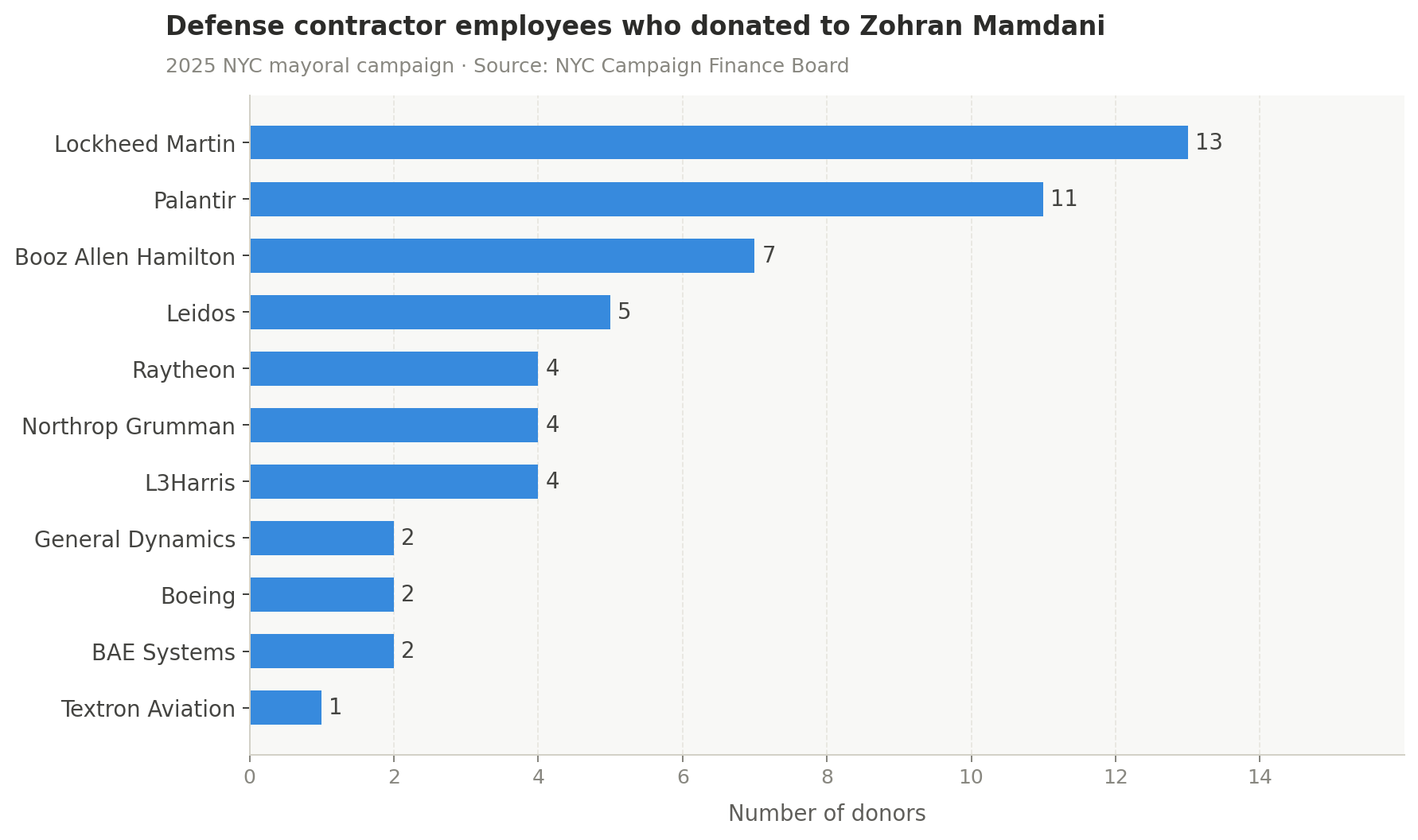
Last Fall, my class was reviewing campaign finance data for the New York City mayoral race. File this under stuff journalism students do. Even in the age of AI, it’s important that reporters know where to find data and what to do with it. What data means is a separate question. And as we found more than 70 donations to Zohran Mamdani from employees at Palantir and a handful of other defense contractors, this question seemed one worth exploring.
Nobody really wants to talk about this, though. No Palantir employees who donated to Mamdani responded to a request for an interview. The same was true for Raytheon, General Dynamics, and most other contractors. And the Mayor Mamdani’s press shop didn’t respond to a request for comment. Yet, one employee did respond. And the interview below shows that while the statistical signal may be insignificant — these donations accounted for less than $5,000 of the more than $4 million Mamdani pulled in during the 2025 campaign — the moral predicament this captures is not.
The behavior isn’t entirely an outlier. Scratching the surface of Congressional campaign finance data, junior Palantir employees — software engineers, recruiters, sales reps—sent money to Rep. Alexandria Ocasio-Cortez, Senators Bernie Sanders and Elizabeth Warren, Rep. Cori Bush, and PACs like Swing Left, Progressive Turnout Project, and Vote Save America. Their boss, Alex Karp, showed what one may call pragmatism (others may see it as the absence of conviction): he donated $360,000 to Kamala Harris in October and November 2023 (before she announced), then $1,000,000 to MAGA, Inc. in December 2024.
The dissonance here may be more of a reflection of our campaign finance system than anything else, but it signals something at the heart of this: individual choice. And what it means to exercise it within the current political and economic realities. I was grateful to find someone willing to talk about this. I’ll call him Defense Engineer. (I’ve concealed personal identifiers to not jeopardize his job with a company that builds, among other things, weapons systems currently being used in Iran, Israel, and Lebanon.)
This conversation has been edited and condensed for readability.
Defense Engineer: Hey, Johnny, this is [Defense Engineer].
Johnny: Hey, [Defense Engineer], how are you?
DE: Doing well, how about you?
Johnny: To kick off, tell me a little bit about your interest in Mamdani and how your donations came about.
DE: Yeah, I think early in his campaign, I took a little bit of interest. I’m a member of DSA, actually. I’m not a super active member, but in my social circles and stuff, Mamdani was someone who was coming up as someone to be excited for. And then summer of last year, I happened to be in New York City [and] saw some of the flyers and started kind of getting more interested, started following the social media campaign and saw “man, this guy is doing it all right.” His messaging was on point as far as what I wanted to hear from a more left-wing side of the aisle and as well as with DSA messaging. My participation with DSA has been a lot of frustrations with National DSA and their weird mix of coalitions in DSA. I was seeing what NYC DSA was doing, as “these guys have it together” in terms of making something real, right? I mean, why are you part of a DSA if you don’t believe at least somewhat in electoral politics? And so I was really excited.
Johnny: Tell me a little bit about your journey to DSA, and I guess, you know, your basic political journey.
DE: Yeah, I feel my journey is probably somewhat common in that high-school-wise I definitely had a bit of an internet edgelord streak, too much time on 4chan. I had a libertarian streak, but I didn’t have very coherent politics. And then in college, that started to melt away, especially 2016. I did not like Trump; I didn’t care for Hillary. I think I, oh God, it’s really one of the most shameful things I ever did is I voted for Gary Johnson.
Johnny: Okay.
DE: I mean, how fucking embarrassing is that?
Johnny: I don’t even remember what his affiliation was.
DE: He was Libertarian Party.
Johnny: Okay.
DE: After 2016, [I] started to be a little bit more apolitical, though I would say I started leaning more towards standard liberalism, laissez-faire liberalism. I started understanding a lot more about what a lot of my female peers in engineering or just you know women in general were dealing with all the time. [I] got more exposed to the adult and working world [and] a lot of other miscellaneous experiences of racism, where I started to be just generally more amenable to liberalism. I would say my hard shift more to farther to the left was 2020. When the interest rates were low, my wife and I were able to buy a house. Part of that was privilege and part of that was luck because my wife didn’t have student loans, but I did. And you know when that market blew up I felt a great deal of guilt and I don’t know if maybe guilt is the I just I was really astonished by how unfair it was that I was able to buy a house where I can now pay a mortgage that’s less than most people’s rent. Most other people of my age were not so lucky or were not so fortunate. That was a real change in a sense of economic inequality and again as well as luck, right? It was this narrow window of time in which we could make that purchase. And then January 6th, there was a real point of “holy shit.” I’d say the thing that’s probably most consistent is I’ve always had a very strong sense of democratic principles. And so that whole— the whole everything leading up to that, the event itself was really earth-shaking for me of , you know, what is— what is going on here? You know, why is the Democratic Party so unable to really handle this? And I mean by this point, I was much more turned towards social democracy, I think I was much more of Bernie, Elizabeth Warren kind of a voter. I had a friend who was already a member of DSA. He had persuaded me over some time where, you know, learning more about Marxism or various leftist philosophy. I think it was ‘23 I joined DSA. I haven’t been super active in this local chapter. I would say kind of where I am politically is democratic socialist. I have to just be very careful about how open I am in the industry I’m in, and also being in [REDACTED], you know, you can’t tell too many people you’re a socialist without it getting you some weird looks. So usually if I talk to anyone about politics I’m never using any labels that would, you know, give me away.
Johnny: Tell me about your arc—or maybe it’s just a straight line—as an engineer. How did your education and career develop?
DE: My interest in becoming an aerospace engineer is around grade school, all the way from grade school. I think it’s kind of—it’s also embarrassing— there’s this general childish love of airplanes and Top Gun, which is unquestionably a propaganda movie, was very influential in my interest in aerospace. I think most people would agree that planes are cool and interesting and military planes and their technology are cool and interesting. If you force yourself to actually confront the politics of it, it becomes kind of a problem. I didn’t really have that confrontation until after my undergrad. After I graduated, I worked for this UAV company called [REDACTED]. It just fucking sickens me now. I think one thing I can say is literally nothing I’ve worked on should have killed anybody. At least as of now, which is good.
After I graduated, I worked for this UAV company called [REDACTED]. It just fucking sickens me now. I think one thing I can say is literally nothing I’ve worked on should have killed anybody. At least as of now, which is good.
I love airplanes. I love aviation and I thought it was really awesome working on these airplanes. That’s what I focused on and less about the mission or why the government was contracting us to do these things. Though I was always more interested in some of the more benevolent reasons. I came out to [REDACTED], started working at [REDACTED] I’d say the majority of what I work on then and still now was commercial or human spaceflight. You know, there’s no getting away that there’s some of these other defense programs where it’s part of the work that the company has. And I’ll say definitely since October 7th it became really hard to tell people that even though I know I don’t work on anything that is deployed there, to even say that I work at [REDACTED]. Like I don’t— it’s—I’m not proud of it.
And so but at that point, we were—we had education assistance to repay, and then we had—there were some places as far as it would have been difficult to transition career-wise. Before Trump took office, what I really wanted to do was go into wind energy or to go and work for the NTSB, or the FAA... I was really thinking or NASA, I was really thinking about a public sector job. But now: fuck no, I’m not at all going to do that. You know, I have friends in the public sector or, you know, they do research stuff and how can I expect any sort of stability out of that or it’s going to be a horrible time.
At least right now I’ve got an offer from [REDACTED] and I’m interested with it’s a unionized engineering workforce. I’ve been thinking a lot about being involved in that. It was—I had explored amongst various coworkers how interested anyone— in a not very direct way—interested in unionizing. And [REDACTED] is not a good name to be associated with either, but I would to work in general aviation. If that doesn’t work out, it might just be commercial spaceflight, you know. My hatred for Elon Musk is so fiery, SpaceX is completely off the table for me.
Johnny: To this broader idea of the ethics of engineering—so much innovation comes out of the defense space, what are your choices if you’re an engineer and you’re socially conscious?
DE: Yeah, so definitely I’ve thought about this a lot. In aerospace it’s very hard to be in the industry and completely escape defense in some way. America’s only kind of really onshore American industry is all of these defense jobs programs. You’re in this very hard spot where you have to keep funding them because if you don’t, there’re next to no skilled industrial jobs for these people to go to. And the ways in which that industry is subject to politics and this commingling of defense is really agonizingly painful where I don’t know—I don’t have a set idea of really what to do about it. Like I don’t—if I were to say be president how would I reallocate this capital towards non-defense purposes? It would be very difficult because so much of the capital is so bespoke towards this pipeline of weaponry.
And of course tons of people buy into these very bullshit ideas about defense. What freaks me out is spending money on interceptor systems because those are escalatory, counterintuitively. You know this Iron Dome stuff. Even before that, there’s another major interceptor system being developed. Before October 7th and the genocide in Gaza, I was able to carry under the illusion that the US won’t get into another evil Iraq War kind of situation. And now I can’t. I can’t ever believe that. I think so much of this is wasteful spending that we’re in a very captive situation.
Before October 7th and the genocide in Gaza, I was able to carry under the illusion that the US won’t get into another evil Iraq War kind of situation. And now I can’t. I can’t ever believe that. I think so much of this is wasteful spending that we’re in a very captive situation.
And I don’t know, it’s a very hard problem where I don’t really know how to roll it back, I just don’t know how radical I can be removing myself from it completely [without] putting myself in a bad position for raising a family. It’s hard. I would have to leave and go to probably Europe to pick up a decent engineering job. Or China I guess, I guess. It’s been a hard thing where the state of the world is not ideal for the life and morals I want to hold to.
Johnny: I think there is—there’s some version of this in every industry, maybe—maybe the line’s a little more direct in defense. In terms of comportment with your colleagues do politics come up? Does any of this stuff come up?
DE: A lot of my close friends in the industry, they’re of surprisingly very similar mindsets. There’s quite a lot of us who are fairly left-wing. Where I work right now, since so much of the work is [REDACTED] or commercial spaceflight, there’s a degree to which you can separate yourself from working too much on a weapons. I’ve got some friends who exclusively work SLS [Space Launch System]. A lot of them, they’ve been trying to leave the industry to avoid defense as much as possible. There’s other folks who I’d say are just come from a different background where from my perspective, they really kind of drank the Kool-Aid of what they work on a lot more. And I don’t—I don’t forcefully argue with them, but I oftentimes will push back, especially, say, for example, the interceptor systems. I pretty often very strongly convey my opposition to them as even a good idea in concept. I spent a lot of time just reading the literature and if you go to kind of the ‘80s, all the literature is from—is written by Americans dealing with the Star Wars program under Reagan. And basically all of it is pretty negative on it because all of them concede this—if you put out a system that can defeat your enemies, that has the innate consequence of then your adversary has to escalate, build more weapons to counteract your interceptor system. Or that right now you make it easier for you to say your enemy’s arsenal, they can’t use it against you, but you can now inflict force against them. I would say actually a very recent case here would be Iran and Israel. Where Iran can launch a lot of rockets at Israel and basically none of them will hit Israel, but that gives Israel a huge amount of ability to strike Iran expecting to be able to get no real significant retaliation. So that’s a kind of a good case of where an interceptor system actually makes things escalatory.
Johnny: Turning back to New York City, Mamdani, DSA—one thing the Left has been criticized for, perhaps more than the right, is, policing of the the politics of candidates and of people within a party. Do you think that there’s room within DSA or within Mamdani’s coalition for people who work within the defense industry?
DE: There’s a couple of things there. For example, the makeup of the engineering force in SPEEA (Society of Professional Engineering Employees in Aerospace union) is 50 percent Republican. So many of these engineers don’t like the Democrats very much, but they vote in these ways where they’re very deleterious to [their] union, right? These Republican administrations hurt the unions quite a lot. But the Republicans will probably give you a lot of red meat in just direct funding or defense contracts. There’s lots of people in the defense industry myself, my friends, who don’t want to be put in this morally bad position. And we really want to be working towards something good. If you want to build a mass movement, you have to in some ways engage just the breath of people who live and work in this country. So I think any sort of purity testing... maybe for candidates you have to do a little bit of purity testing, but for the voters themselves, you know, engage everyone as much as you can.
I think—and you know if a lot of leftists want to criticize me for lacking moral fortitude or courage…I recently read One Day Everyone Will Have Always Been Against This, and it made me think a lot about. Should I have just resigned on principle, seeing the genocide in Gaza? And you know does that make me, you know, complicit and a coward and, you know, you... it’s hard to not answer and maybe that answer is yes.
Should I have just resigned on principle, seeing the genocide in Gaza? And you know does that make me, you know, complicit and a coward and, you know, you... it’s hard to not answer and maybe that answer is yes.
And but you know there’s it—we live in a society where there’s... well, I think it’s sometimes a cop-out to say, you know, there’s no ethical consumption under capitalism or have that sort of argument, but we live in a society that doesn’t give us a lot of good options. And those options have been restricted so much more. All of us have to make choices where we frequently are just always forced to operate under systems and in societies that we don’t want to. And you have to do the good that you can.
Johnny: I think that could also be said of being mayor of New York City, particularly in a moment when the federal government’s very hostile to funding things that the city needs funded. What—I mean, how do you think Mamdani should navigate this same sort of fraught moral, ethical, political landscape that you have?
DE: Uh, that’s a good question. His platform of affordability, I think, as long as he can stay as committed to that as possible. I think there’s no getting away that you probably have to do a little bit of concessions to just get something that works that starts to help people and keep building political momentum and grow the base and gain support. It’s really important that he doesn’t fail on delivering his promises of making cheaper and better services for New Yorkers and that doesn’t—that—and that payment for that doesn’t come from, you know, the people who are already struggling. You know, that has to come from the people who have more than enough to contribute to the city to fund that.
I think there’d have to be some a Fetterman-esque turn to the dark side to really see a loss of support. It’s going to be a hard—it’s a hard fight to kind of claw left-wing power away from the pervasive liberal hegemony and the more really entrenched right-wing all over the country. So any little gains towards building power, I’m for it. And I won’t take any of it for granted.
Johnny: Yeah. Well, thank you, thank you so much.